Hayvenhurst_
A live code graph for people and coding agents.
A persistent, trace-augmented code graph that answers structural questions about a repository without sending source code to the cloud.
How it works
Parse the repository
Maintain a live graph
Measure impact and tests
The problem
Coding work is full of structural questions: what calls this function, what could this change break, and which tests can actually reach it? Text search finds matching strings, but it does not understand the relationships between symbols.
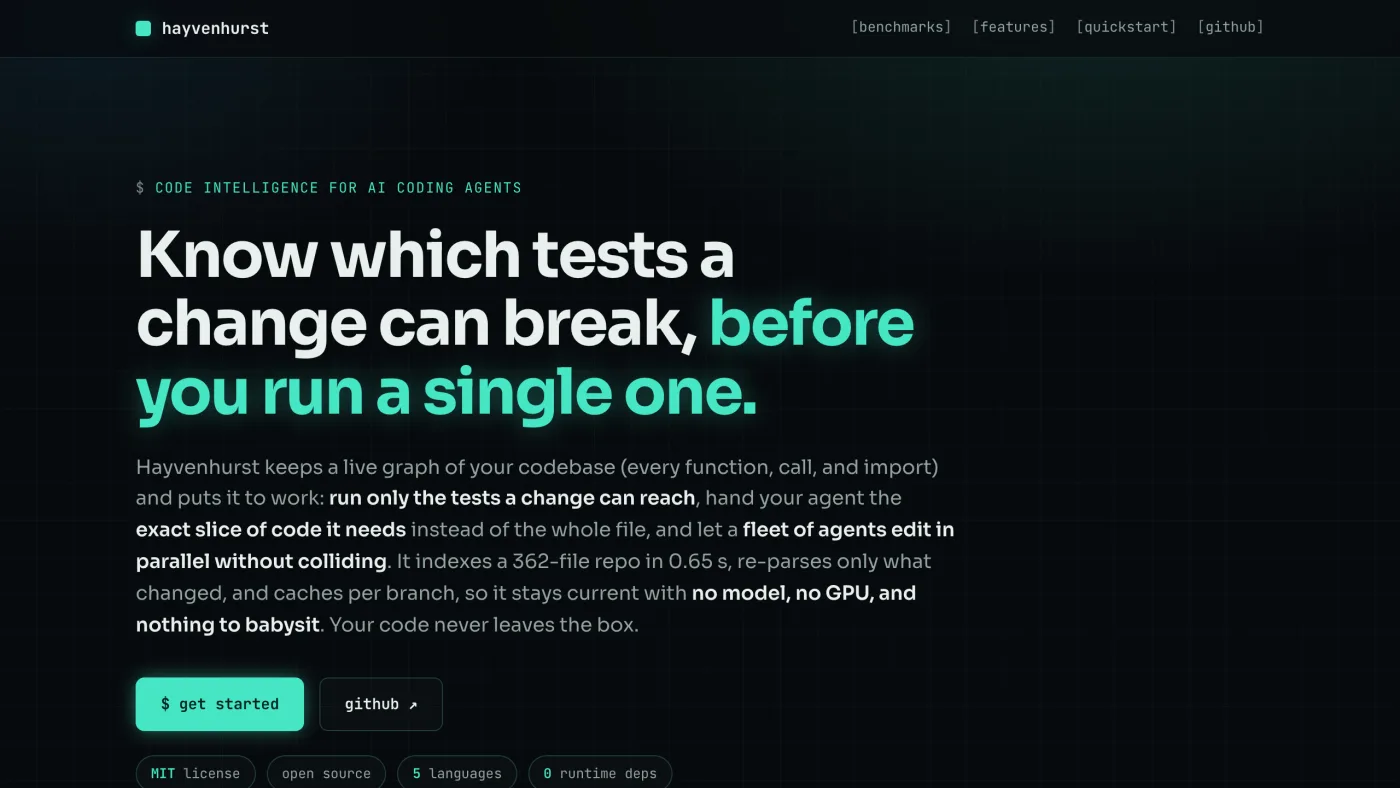
Hayvenhurst keeps a live graph of functions, classes, calls, and imports, then augments that graph with runtime traces. The result is a local source of truth that developers and coding agents can query without loading entire repositories into a context window.
What it does
- Indexes Python, TypeScript, JavaScript, Rust, and Go through a Rust parser.
- Walks callers, callees, imports, and transitive blast radius.
- Combines static relationships with runtime traces to select affected tests.
- Produces line-exact context slices for agents.
- Coordinates parallel work with claims scoped to code entities instead of entire files.
- Stores its graph locally in SQLite with no embeddings, GPU, or cloud account.
Engineering approach
The system separates a fast native indexing layer from a Bun daemon and CLI. A file watcher incrementally updates the graph, while per-branch caches make repository switching inexpensive. The HTTP API, CLI, MCP surface, and SVG viewer all operate over the same graph.
Performance claims are backed by the benchmark harness committed in the repository, including a 0.65 second cold index of the Hono codebase and millisecond-scale cached branch reads.
Where it fits
Hayvenhurst supplies code intelligence to the wider Sothis toolchain. Sirius Forester uses it for symbol-level locks, impact-aware test selection, and provenance; other agents can use it directly through the CLI, HTTP API, or MCP server.
Current status
Hayvenhurst is pre-release software with checksum-verified binaries for macOS, Linux, and Windows. Its architecture, integration guides, benchmarks, and release process are public and inspectable.