CarbillPro: CRM and Follow-Up Automation for Auto Service_
"A CRM rebuild and automated post-service follow-up for a regional auto service group. The system now runs as CarbillPro."
Published with the client's permission. The system built in this engagement now runs as CarbillPro. Implementation details of the stack are withheld.
 Automotive Services
Challenge
A regional auto service group was losing repeat business it should have been winning. The pattern was consistent: a customer would come in for a repair, get quality work, leave happy, and never come back for routine service. Oil changes, tire rotations, and seasonal maintenance were quietly slipping to competitors.
The mechanics were doing their jobs. The problem was upstream:
- Fragmented customer data. Records were split across the shop management system, a spreadsheet the front desk maintained, and the memory of the service advisor. There was no single view of a customer’s service history.
- No follow-up loop. After a service, nothing systematic happened. No reminder for the next oil change. No prompt for the tire rotation they were told they’d need in 5,000 miles. No check-in on the maintenance items deferred at the last visit.
- Zero visibility into what worked. Management couldn’t answer basic questions: which service intervals generated repeat visits, which customers were at risk of churning, which upsell recommendations actually converted.
Solution
We approached this as three problems, not one: understand the current state, replace the CRM foundation, then automate the follow-up loop on top of clean data.
Phase 1: CRM audit and analysis
Before touching the stack, we spent two weeks in the data. We consolidated three years of service records into a single view and ran a cohort analysis on the customer base. The findings were sharp:
- 61% of first-time customers never returned for routine maintenance.
- Customers who received a manual follow-up call had a 4x higher return rate than those who did not.
- The top three service-interval reminders (oil, rotation, brake inspection) accounted for the majority of missed revenue.
This gave us the business case and the shape of the automation to build.
Phase 2: CRM rebuild
We replaced the fragmented setup with a purpose-built CRM structured around the customer + vehicle + service-history graph the shop actually operated on. Migrated three years of historical records. Integrated with the existing shop management system for two-way sync so service advisors kept working in the tool they knew.
Phase 3: Follow-up automation
On top of the clean CRM, we built the follow-up engine. Every service creates a set of downstream triggers based on the work performed:
- SMS reminder for the next oil change based on mileage and interval.
- Email nudge for deferred maintenance items 30 days later.
- Seasonal outreach for tire rotation, AC service, and battery checks.
- Personalized upsell prompts based on the customer’s vehicle history and prior recommendations.
All orchestrated through a workflow engine the shop owner could see, edit, and audit without waiting on us.
Technical Implementation
System Architecture


All of it runs on Railway: the database, the services, and the scheduled jobs on one platform, so there is a single place to deploy, watch, and roll back.
Analytics Dashboard
The dashboard gave management the visibility they were missing. Live views on:
- Cohort retention: how each month’s new customers behaved over the following 12 months.
- Churn risk: customers overdue for their next expected service, ranked by lifetime value.
- Upsell conversion: which recommended services actually get booked, segmented by advisor and vehicle type.
- Campaign performance: open, click, and reply rates on every automated touchpoint.
Built as an admin app reading the same database the automation writes to, so numbers stayed consistent across ops and reporting.
Results
| Metric | Before | After | Change |
|---|---|---|---|
| Customer return rate (routine service) | ~22% | 85% | +63 pts |
| Upsell service revenue | baseline | +30% | +30% |
| Cashflow variance month-to-month | high | flattened | major |
| First-time customer 12-month retention | 39% | 82% | +43 pts |
Impact
- 85% of customers return for routine service (oil changes, tire rotations) after the follow-up loop was live. What was slipping to competitors now stays in-house.
- 30% increase in upsell revenue as recommendations reach customers at the right moment with context on their vehicle history, not as generic email blasts.
- Cashflow smoothed month-to-month. Predictable follow-up cadence turned seasonal revenue swings into a steadier baseline, which changed how the owner could plan hiring, inventory, and capex.
- Ops runs on a system, not a Rolodex. The customer relationship no longer lives in a service advisor’s head. When someone leaves, the pipeline keeps running.
The product
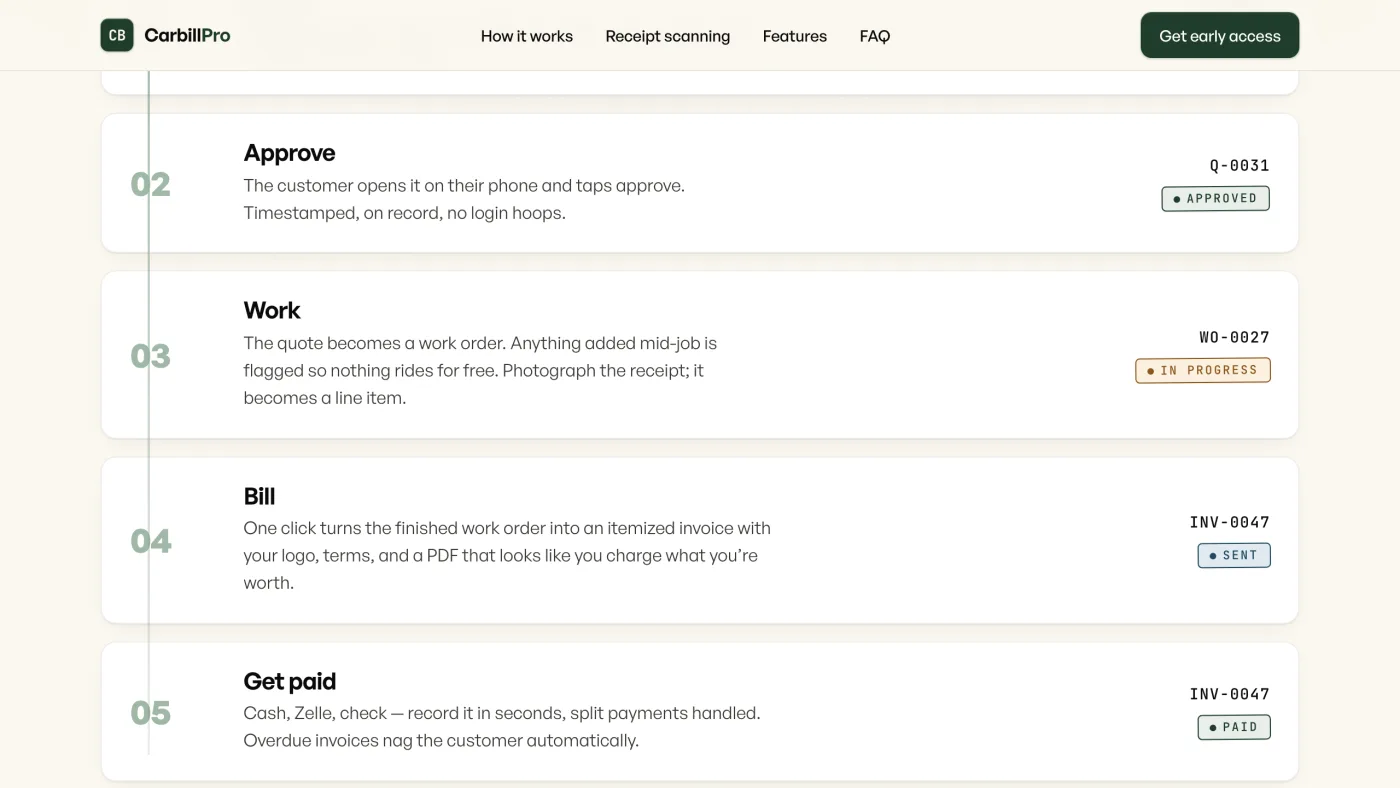
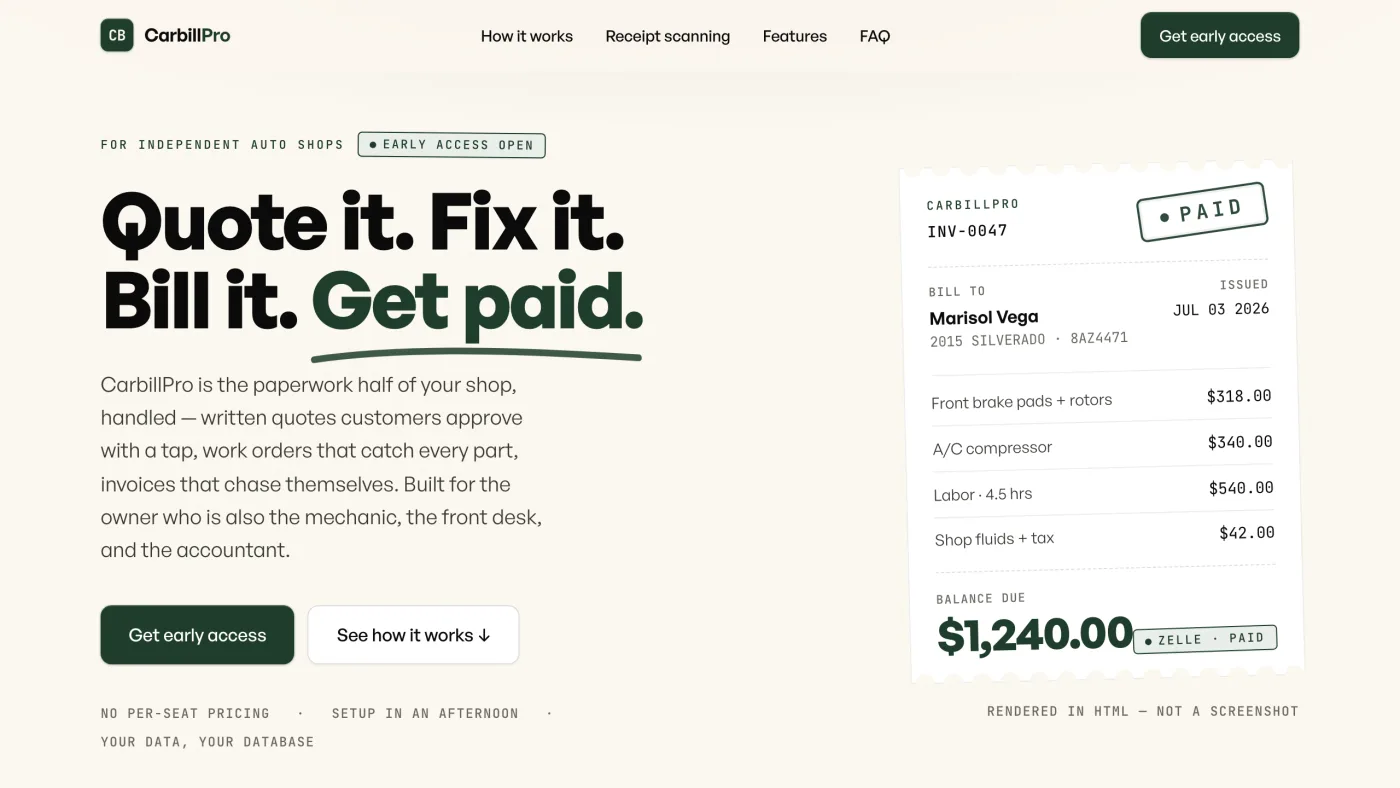
The system built here now runs as CarbillPro, in early access for independent shops — quotes customers approve in writing, work orders that catch every part added mid-job, and invoices that chase themselves.
The same record follows a car from the first quote to the last dollar, so nothing is re-typed between the counter and the invoice.